
Overview: Course
The Specification for Junior Cycle Modern Foreign Languages (
JC
Junior Cycle
MFL
Modern Foreign Languages
) is designed for a minimum of 200 hours of timetabled student engagement and is organised around three integrated strands: Communicative competence, Language awareness and Socio-cultural knowledge and
Intercultural awareness
An awareness of the student’s own and other cultures, values and beliefs. It builds understanding, empathy, respect, and acceptance of other people and cultures by focusing on the development of specific knowledge, attitudes and skills.
.
These strands are each further broken down into elements and the learning outcomes associated with each element are also specified.
The strand Communicative competence is concerned with developing students’ ability to communicate meaningfully in the target language.
The strand Language awareness enhances students’ general awareness about languages, the skill of language learning and their developing awareness of themselves as language learners.
The strand Socio-cultural knowledge and
Intercultural awareness
An awareness of the student’s own and other cultures, values and beliefs. It builds understanding, empathy, respect, and acceptance of other people and cultures by focusing on the development of specific knowledge, attitudes and skills.
emphasises that languages and cultures are inextricably linked. It allows students to gain access to new cultural dimensions and encourages them to reflect on their own culture.
Language use is central to the development of overall language proficiency. Students develop communicative competence through reflective language use which, in turn, informs and is informed by the development of socio-cultural knowledge and
Intercultural awareness
An awareness of the student’s own and other cultures, values and beliefs. It builds understanding, empathy, respect, and acceptance of other people and cultures by focusing on the development of specific knowledge, attitudes and skills.
.
While the learning outcomes associated with each strand are set out separately in this specification, this should not be taken to imply that the strands are to be studied in isolation.
Students’ language learning is actively supported when their communicative competence, language awareness and socio-cultural knowledge and
Intercultural awareness
An awareness of the student’s own and other cultures, values and beliefs. It builds understanding, empathy, respect, and acceptance of other people and cultures by focusing on the development of specific knowledge, attitudes and skills.
are developed in an integrated way. Likewise, the elements associated with each strand, although set out separately, cannot be taught in isolation.
Communication is usually multi-modal, where reading, writing, listening, and speaking enable meaningful communication. Students’ growing awareness of grammar, syntax and pronunciation aids effective communication and, as such, these aspects of language learning are taught in the communicative context of the tasks and activities outlined in Strand 1.
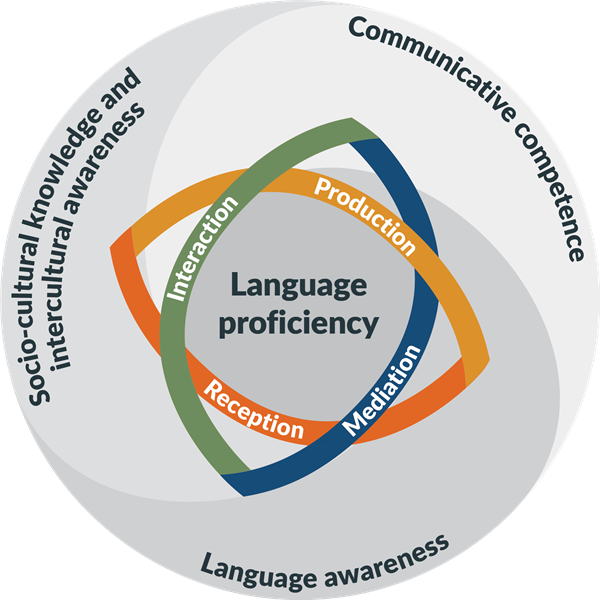
The inter-relatedness of the three strands