
Expectations for Students
Expectations for students are set out in three integrated strands. An overview of each strand is provided below, followed by the learning outcomes which describe the knowledge, understanding, skills and values students should be able to demonstrate having studied modern foreign languages in junior cycle.
The outcomes are numbered within each strand. The numbering is intended to support teacher planning in the first instance and does not imply any hierarchy of importance across the outcomes themselves.
Junior cycle modern foreign languages are offered at a common level. The
JC
Junior Cycle
MFL
Modern Foreign Languages
specification sets out what is expected of students at the end of their three years of study. As such, the learning outcomes focused on at a point in time will not have been ‘completed’ but will continue to support the students’ learning of modern foreign languages up to the end of junior cycle.
The learning outcomes describe what students will be expected to be able to do in the target language. The learning outcomes are broadly aligned to the A band of the
CEFR
The Common European Framework of Reference for Languages: Learning, Teaching, Assessment was published by the Council of Europe in 2001. This framework of reference provides tools, guidelines, and resources to support the teaching, learning and assessment of languages.
(A1-A2). They refer to language tasks and activities which reflect simple everyday interactions across the three domains of language use (public, personal and educational9) , which are relevant to the students’ age and experience, and are designed to lend themselves to differentiated teaching, learning and assessment. Across all strands, students should be given every opportunity to use a range of media to display and present what they have learned.
9. Click here for further supports on the personal, education and public domains of languages use.
Communicative competence enables students to communicate effectively in the target language for meaningful purposes. In this strand, students engage in language activities and tasks across the public, personal and educational domains of language use involving the four modes of communication identified in the CEFR and CEFR CV10. The four integrated modes of communication reflect real-life language use, which often involves a number of activities. Figure 5 illustrates the interconnected and interrelated nature of the four elements. Active engagement with the learning outcomes in this strand further supports the development of language awareness, sociocultural knowledge and intercultural awareness.
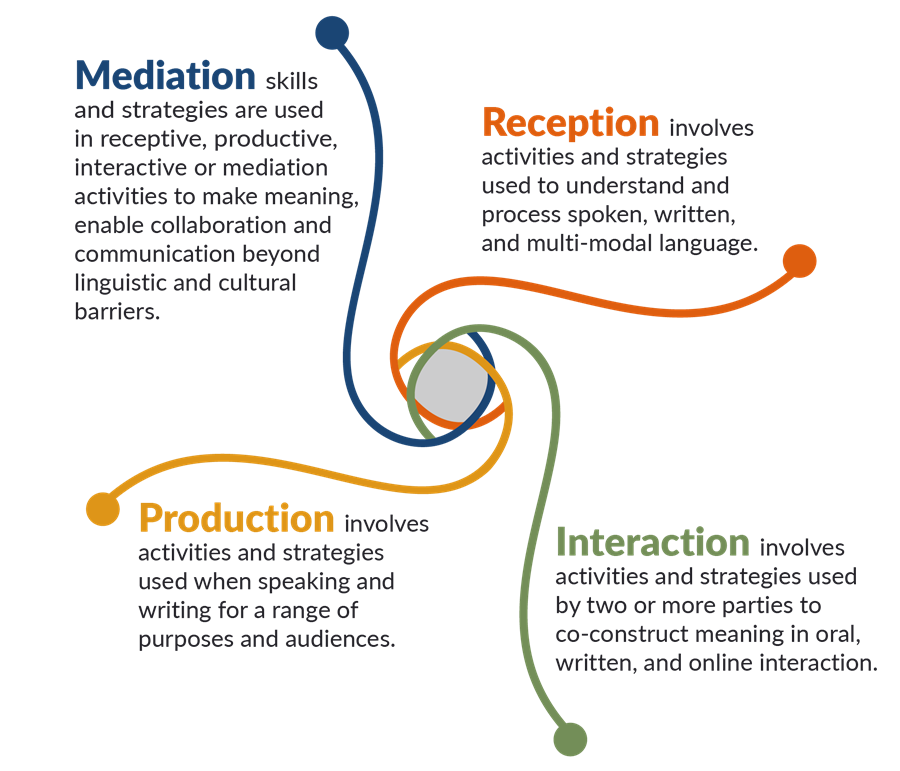
The interconnected and interrelated nature of the four elements
10. CEFR CV, Council of Europe, 2020, p.34
| Students learn about | Students should be able to |
|---|---|
|
Reception
Understanding and processing written, spoken and multimodal language |
|
|
Interaction
Co-constructing meaning in oral, written and online interaction |
|
|
Production
Speaking and writing for a range of purposes and audiences |
|
|
Mediation
Developing skills and strategies to make meaning and enable communication beyond linguistic and cultural barriers |
|
Language awareness draws on students’ existing linguistic resources and enhances the students’ general awareness about languages and language learning. In this strand, students analyse how the target language works, they compare it to the languages they know (English, Irish and/or their mother tongue) and they reflect on their own developing plurilingual repertoire. Active engagement with the learning outcomes of this strand supports the development of communicative competence, sociocultural knowledge and intercultural awareness.
| Students learn about | Students should be able to |
|---|---|
| Understanding how the target language works |
|
| Comparing the target language with other languages they know |
|
| Reflecting on how they use and learn languages |
|
Socio-cultural knowledge and intercultural awareness give students access to new cultural dimensions and encourages them to reflect on their own culture. In this strand, students acquire knowledge about the target language countries and communities, and are encouraged to develop attitudes of curiosity, openness and empathy towards cultural groups that are different to their own. Active engagement with the learning outcomes in this strand supports students in deepening their awareness of the target language and the link between languages and cultures, and further enables them to develop their communicative competence and language awareness.
| Students learn about | Students should be able to |
|---|---|
| Learning about relevant facts, people, places and history about the countries and communities related to the target language |
|
| Learning about traditions, customs and behaviours |
|
| Comparing their culture with that of the countries and communities related to the target language |
|