
Learning Outcomes
Stage 1Junior and senior infants |
Stage 2First and second classes |
Stage 3Third and fourth classes |
Stage 4Fifth and sixth classes |
| Through appropriately playful and engaging learning experiences, children should be able to | |||
|
develop a sense of ten as the foundation for place value and counting. |
understand that digits have different values depending on their place or position in a number. use estimation to quickly determine number values and number calculations. |
explore equivalent numerical expressions of numbers using the base ten system. |
investigate how decimals and percentages (and fractions) can be compared, ordered and expressed in related terms. |
|
Numbers can be distinguished according to their quantitative value. The base of our number system is ten. The base-ten number system consists of 10 digits and is based on groups of ten. In a 2-digit number, the digit to the left denotes the greater value. |
The value of a digit in a number depends on its place. The position of a digit denotes a value ten times that of the digit to its right. When ten place value units (e.g. ones, tens) are grouped, a new place value unit (e.g. ten, hundred) is formed. The relationship between one quantity and another quantity can be an equality or inequality relation. 0 can be used as a placeholder, allowing us to record a number accurately. Numbers can be rounded or approximated to provide estimations of value. |
The value of each digit in an integer or decimal number is a multiple of the value of its place. The value of an integer or decimal number is represented by the value of the sum of each of its constituent digits. The principle of base ten holds for integers and decimals. Notwithstanding the conventional notation, numbers can be represented in different, equivalent ways using concrete materials (e.g. 46 = 4 tens and 6 units or 3 tens and 16 units). A decimal point is a convention that separates the integer part of the number (left) from the fraction part of the number (right). The base ten place value system extends indefinitely in two directions multiplying (to the left) or dividing (to the right) by multiples of ten. |
Fractions, decimals and percentages are three ways of expressing part-whole relationships. A rational number is any number that can be written as a fraction, where both the numerator and the denominator are integers, and the denominator is not equal to zero. Multiples of 10 are a useful tool for converting between fractions, decimals and percentages. A percentage is a way of expressing a fraction of one hundred or another way of writing hundredth. Per ‘cent’ means out of a hundred and uses the % notation. |
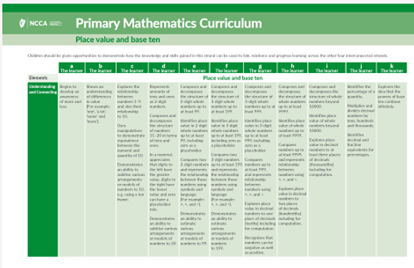
Click on the image to access the progression continuum for the strand unit of 'Place value and base ten'
-
Directory of Support Materials
Directory of Support Materials: Place value and base ten
-
Suggestions for children's learning
Support material
-
-
Suggestions for key language
Support material
-
Suggestions for the learning environment
Support material
-
Suggestions for learning at home
Support material