
Learning Outcomes
Stage 1Junior and senior infants |
Stage 2First and second classes |
Stage 3Third and fourth classes |
Stage 4Fifth and sixth classes |
| Through appropriately playful and engaging learning experiences, children should be able to | |||
|
interpret the meaning of symbols or pictures in number sentences. |
represent and express problems with known and unknown values in different ways to include the use of appropriate letter-symbols or words. |
articulate, represent and solve mathematical situations through the use of expressions and equations that include letter-symbols. |
|
|
Real-life situations can be expressed using manipulatives, diagrams, and word and number sentences. An equals sign (=) conveys equality, whereas ≠, < and > convey inequality. In number sentences (equations), symbols can stand for a request to do something (+, -, x, ÷), they can express a relationship (=, <, >, ≠), or they can be something that is unknown or varies. In a number sentence, number facts can be applied to help find an unknown value. |
When expressing real-life situations, symbols can be used to represent an unknown, a quantity that varies (variable), or every number (the general case). Real-life situations and functions can be represented in a variety of forms, including numbers, words, symbols and tables. A function is a special relationship where each input has exactly one output. There are always three main parts; the input, the functional relationship and the output. Representing the structure of a function using words, symbols, graphs, tables or diagrams is useful to identify outputs for given inputs and vice versa. |
A real-life situation can be represented by an expression or a series of expressions. An expression may contain more than one unknown or variable. Each unknown or variable must be represented by a dedicated symbol. When generating an expression to represent a real-life situation, it can be possible and useful to ‘simplify’ a long or complex expression. ‘Solving’ an equation consists of determining which value(s) for a given symbol make(s) the equation true. |
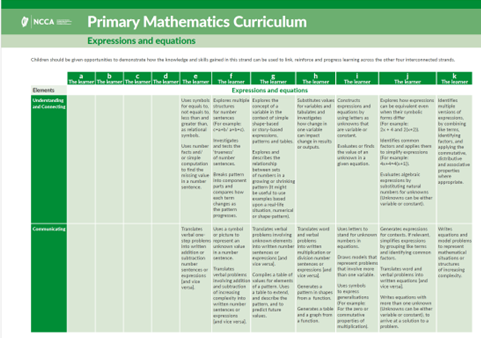
Click on the image to access the progression continuum for the strand unit of 'Expressions and equations'
-
Directory of Support Materials
Directory of Support Materials: Expressions and equations
-
Suggestions for children's learning
Support material
-
-
Suggestions for key language
Support material
-
Suggestions for the learning environment
Support material
-
Suggestions for learning at home
Support material