
Learning Outcomes
Stage 1Junior and senior infants |
Stage 2First and second classes |
Stage 3Third and fourth classes |
Stage 4Fifth and sixth classes |
| Through appropriately playful and engaging learning experiences, children should be able to | |||
|
recognise and understand what happens when quantities (sets) are partitioned and combined. |
select, make use of and represent a range of addition and subtraction strategies. |
understand and apply flexibly the four operations; and the relationships between operations. |
build upon, select and make use of a range of operation strategies. |
|
Quantities (or sets) can be partitioned and combined. Adding a natural number to a natural number makes the number (quantity) bigger. Subtracting a natural number from a natural number makes the number (quantity) smaller. This can be represented as a move on the number line or 100 square. A whole number does not change when adding or subtracting zero from that number. Addition and subtraction have an inverse relationship. |
Commutative, associative, additive identity and distributive are significant properties of addition. Numbers and symbols are used to construct and express number sentences. These can help to solve problems or are used to express contexts mathematically. When combining or partitioning numbers, we sometimes need to exchange tens to units, or hundreds to tens where necessary. A number fact is a mental picture of the relationship between a number and the parts that combine to make it. Representations of subtraction can include reduction, complement and difference. |
Commutative, associative, identity and distributive properties apply to the operation of multiplication. One definition of multiplication is having a certain number of groups of the same size. An early representation of multiplication is repeated addition. The principles used when performing operations on whole numbers are very similar for decimal numbers, with consideration needed on how to handle the decimal point. Division can be described as the splitting of a number into equal parts or groups, or the repeated subtraction of a number. Multiplication and division have an inverse relationship. Use of a calculator can reduce computative focus allowing for increased focus on strategies. |
Estimation and rounding are useful to test the reasonableness of answers to more complex operations. For fractional and decimal computation, new and amended algorithms are needed as some meanings of whole number operations may be difficult to apply. A prime number has exactly two factors – itself and one, a composite number has three or more factors. The number one is neither prime nor composite. Factors are numbers that multiply together to give a product. Multiples are the result of multiplying a whole number by a whole number (or an integer by an integer). |
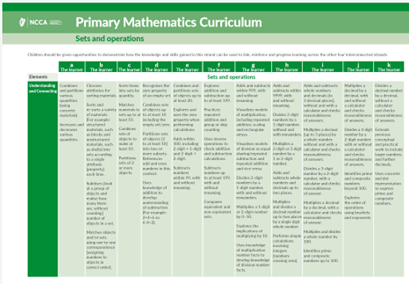
Click on the image to access the progression continuum for the strand unit of 'Sets and operations'
-
Directory of Support Materials
Directory of Support Materials: Sets and operations
-
Sets and operations: Suggestions for children's learning
Support material
-
Sets and operations: Suggestions for teaching
Support material
-
Sets and operations: Suggestions for key language
Support material
-
Sets and operations: Suggestions for learning environment
Support material
-
Sets and operations: Suggestions for learning at home
Support material