
Learning Outcomes
Stage 1Junior and senior infants |
Stage 2First and second classes |
Stage 3Third and fourth classes |
Stage 4Fifth and sixth classes |
| Through appropriately playful and engaging learning experiences, children should be able to | |||
|
describe and test predictability and (un)certainty in events. |
use probability to make informed decisions and predictions. represent and express probability in different forms. |
||
|
Events in everyday life involve chance. Some events are more likely to happen than others. If an event is unlikely to happen, it has a low probability. If something is likely to happen, it has a high probability. Expected or predicted outcomes of an event can differ from actual outcomes. Investigating chance allows decision-making and predictions about everyday events and occurrences. |
Probability can be represented on a scale between 0 – 1. The experimental probability of an event occurring may not always match the theoretical probability. The probability that a specific outcome will occur can be represented as a fraction, decimal or percentage. A sample space contains all possible outcomes of an experiment. Probability can be described in proportional terms and is calculated by dividing the number of ways the identified outcome can happen over the total number of possible outcomes. As you repeat a trial independently a large number of times, the average result becomes increasingly closer to the expected value. |
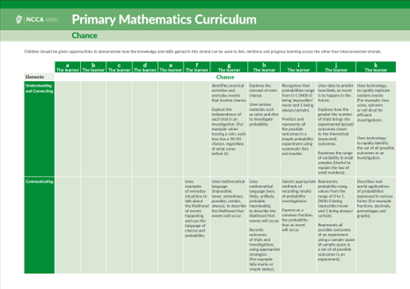
Click on the image to access the progression continuum for the strand unit of 'Chance'
-
Directory of Support Materials
Directory of Support Materials: Chance
-
Chance: Suggestions for children's learning
Support material
-
-
-
Chance: Suggestions for learning environment
Support material
-