
Learning Outcomes
Stage 1Junior and senior infants |
Stage 2First and second classes |
Stage 3Third and fourth classes |
Stage 4Fifth and sixth classes |
| Through appropriately playful and engaging learning experiences, children should be able to | |||
|
develop an awareness that the purpose of counting is to quantify. use a range of counting strategies for a range of purposes. |
demonstrate proficiency in using and applying different counting strategies. |
||
|
Quantities can be subitised and compared without needing to count or assign a numerical value. There are five principles of counting; one-one, stable order, cardinal, order irrelevance and abstraction. The last number in the count indicates the quantity in a set. There are a range of counting strategies, including grouping objects and arranging objects in various visual configurations. |
Estimation and counting strategies can be applied to determine quantities / calculations. The reasonableness of estimations can be tested by counting. There are a range of strategies for counting forwards and backwards. |
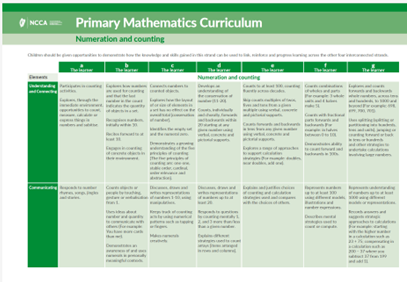
Click on the image to access the progression continuum for the strand unit of 'Numeration and counting'
-
Directory of Support Materials
Directory of Support Materials: Numeration and counting
-
Suggestions for children's learning
Support material
-
-
-
Suggestions for the learning environment
Support material
-
Suggestions for learning at home
Support material